
I have sat in too many portfolio reviews where a product that is six months old and a product that is ten years old were judged with the same questions. Where is the revenue? Why is the roadmap so thin? Why are customers not asking for more? Each of those questions is fair for one product and unfair for the other.
The fix I keep coming back to is simple: give every product an age. Not in years, but in lifecycle stage. Once a team agrees where a product sits on its curve, the conversation changes. We stop arguing about whether the product is doing well and start asking whether it is doing what a product at that stage should do.
Nothing here is new theory. It borrows from two ideas most of us met early in our careers, the S-curve of innovation and the BCG growth-share matrix. What I have found useful is turning them into a working language a product team can use every week.
Four stages, four different jobs
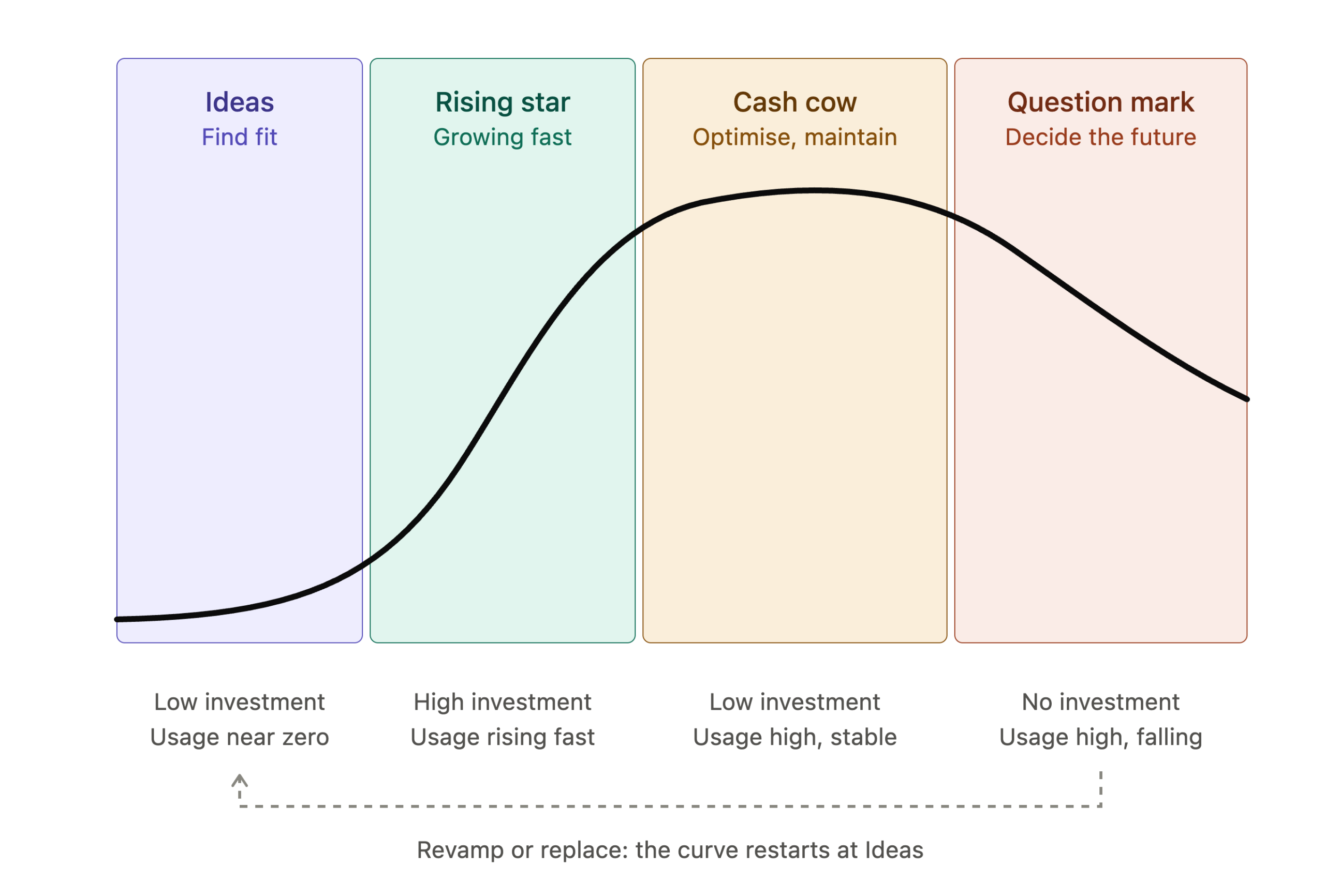
I use four names. They are deliberately plain, so anyone can say them in a meeting without a slide explaining the framework.
Ideas
The product has little or no usage yet, and that is fine. This is the hungry phase: discovery, customer conversations, prototypes, proofs of concept, a north star, an MVP and finally the first customer live in production. Investment is focused and runs well ahead of usage. The only question that matters is whether we are right. A good week is a customer conversation that changes the plan.
Rising star
The first customer is live and feedback starts to flow. Incremental releases ship, new customers come in, and the blockers that stop the next customer are removed one by one. Growth is high and investment is at its peak. This is also where products quietly fail: if sales cannot sell it or customers do not adopt it, the curve flattens before it ever gets high. Seeing that early is a success, not a failure. A good week is a new customer onboarded without custom work.
Cash cow
Usage is high and stable, growth is minimal and customers are happy. There is little friction left to remove. The work is small improvements, optimisation, bug fixing and maintenance, with modest investment and high return. This is the product that funds everything else. Its biggest risk is neglect: a cash cow nobody watches slides into decline without anyone deciding it should. A good week is a quiet one.
Question mark
The product has aged. Usage is still meaningful but declining. Competitors are winning on experience or capability, and the market’s expectations have moved on. A decision is now unavoidable, and doing nothing is also a decision. There are three options: revamp the product and give it new life, replace it with something new, or deprecate it and leave that market. A good week is a decision made, with an owner, a date and a plan for telling customers.
A note for BCG purists: in the classic matrix the question mark sits at the young, high-growth end. I use it for the aging stage on purpose, because that is where the question is truly open.
Where products sit
Put usage on one axis and investment on the other, and the four stages fall into four clean quadrants. The useful part is the movement: healthy products travel clockwise, and a revamp or replacement is the dashed path back to Ideas.
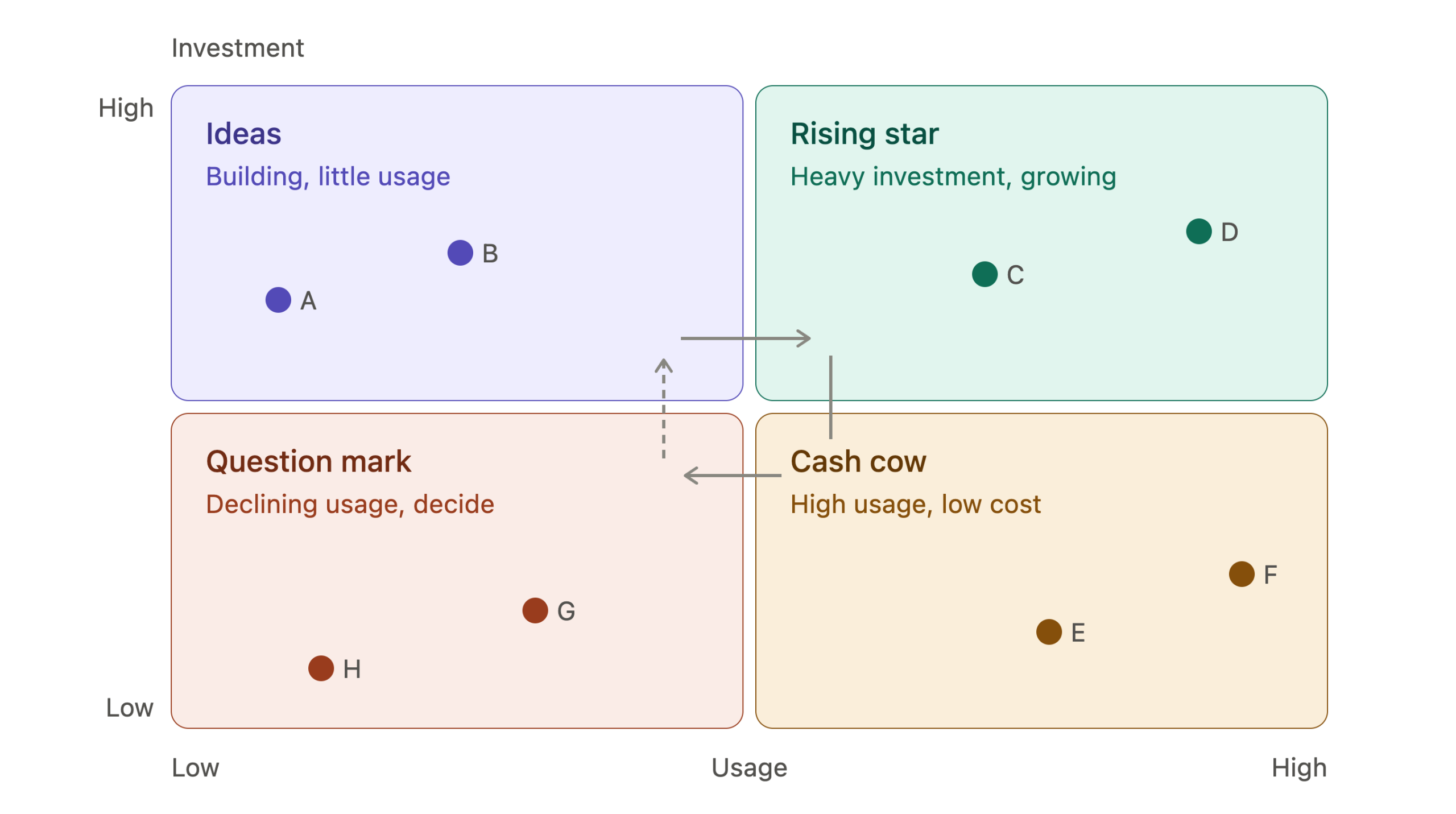
lifecycle matrix · usage vs investment, four quadrants
Not every curve looks the same
The textbook S-curve is a useful starting point, but real products bend it in different ways. Recognising which shape you are on matters more than the label itself.
A typical product rises, plateaus and declines over a few years. A long-lasting product reaches its plateau and stays there for a very long time; in my experience these are the backbone of a portfolio, and they deserve more care than they usually get. A low-growth product never really takes off. It is not a cash cow in waiting, and calling that early frees the team for something better.
At the decision point, the curve splits. A revamped or replaced product starts a new curve, ideally before the old one has fallen far, and can climb above the old peak. A deprecated product is wound down on purpose: customers are migrated, usage falls to zero by a planned end-of-life date, and the team moves on. Both are healthy outcomes. The unhealthy one is the product that declines slowly for years because nobody made the call.
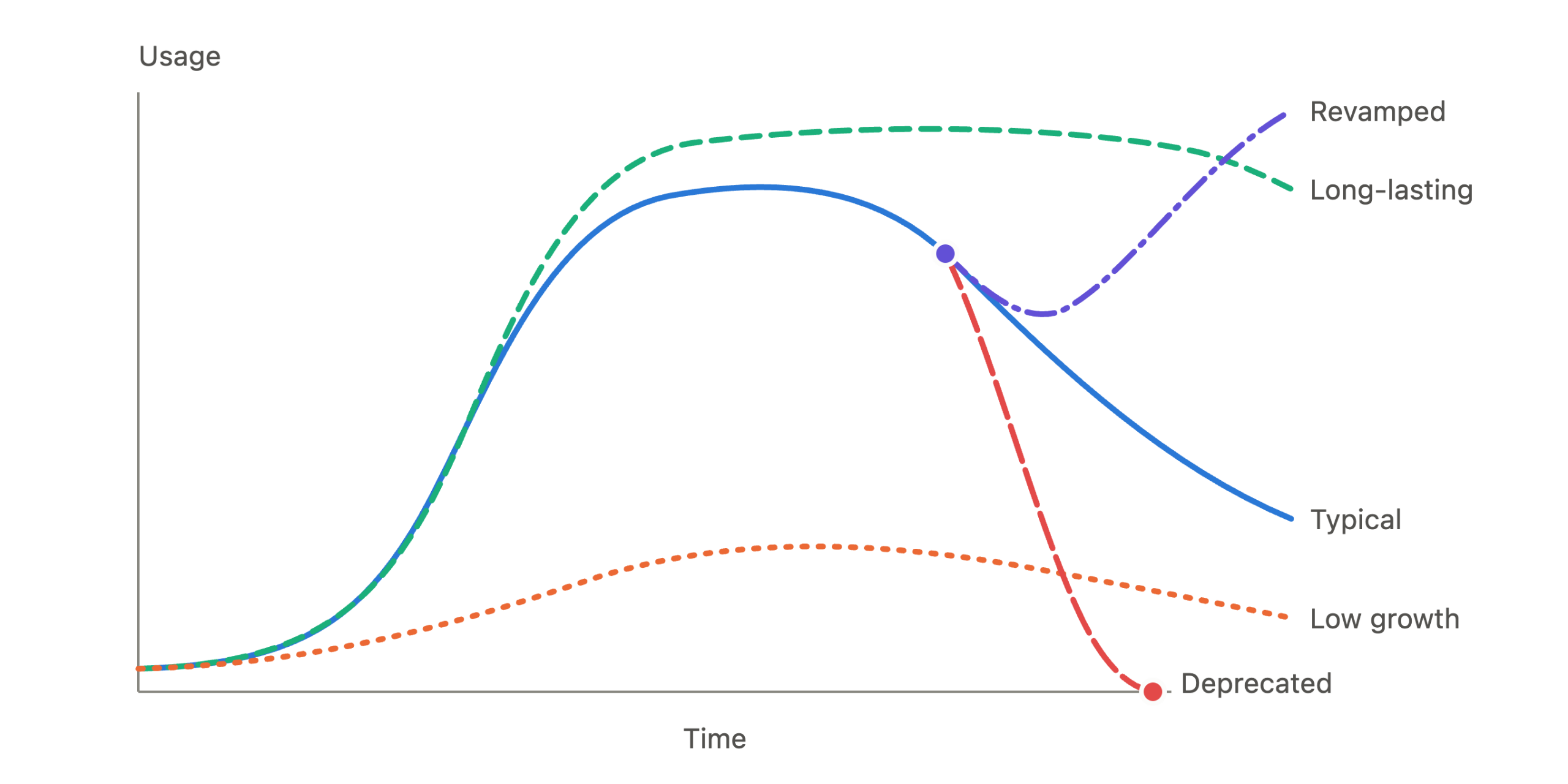
S-curve variations · five product cases
The shapes are illustrative, not measured. What matters is which one your product resembles, and whether you have noticed.
Putting it to work
A framework only helps if it changes decisions. Here is how I would use it with a product team.
First, label every product, and write down the criteria so the call does not depend on who is in the room. Usage trend, growth rate, level of investment and customer feedback are usually enough. Second, review the labels on a fixed cadence, every half year works well, because products move between stages more quietly than we expect.
Third, and most important, judge each product by the yardstick of its stage. Ideas are judged on learning. Rising stars on adoption and growth. Cash cows on stability and cost to serve. Question marks on the quality and speed of the decision. The same applies to the product managers who own them: someone running a cash cow and someone chasing product-market fit are doing very different jobs, and both deserve to be measured fairly.
Finally, put the stage next to everything else stakeholders already look at: the owner, the north star, the roadmap, the usage. When everyone sees the same picture, alignment takes far fewer meetings.
The real value is the conversation
The S-curve and the BCG matrix are decades old. What makes them useful is not the theory but the shared language: a team that can say “this is a cash cow, and it is starting to look like a question mark” has already done half the work. So ask yourself where each of your products sits today, and whether you are managing it for the stage it is actually in.